
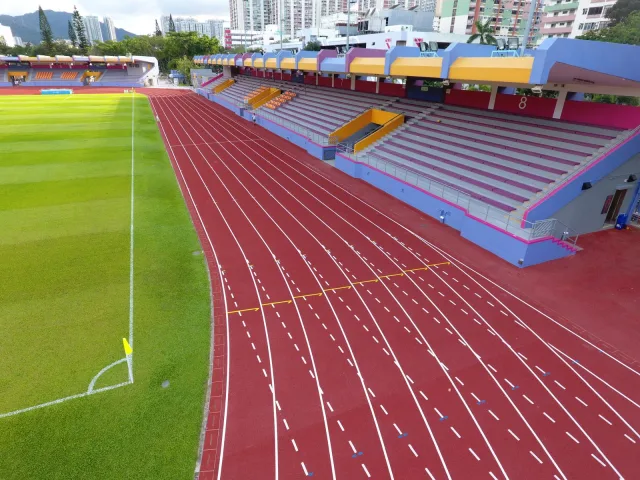
Nothing kills a first track session faster than arriving in your running kit and finding a school sports day in full swing.
Hong Kong's public sports grounds are still some of the easiest places to get a measured run done. The surface is flat, the lap distance is known, and many tracks are free during public jogging sessions. The catch is that a sports ground is not a park: bookings, competitions, maintenance and even a football match on the infield can change which lanes are available.
A quick check before you leave will usually save a wasted journey.
Check the day and time, not just the opening hours
A venue closing at 11pm does not mean its running track is available at 10pm. The same track may have public jogging in the morning and a private booking later that day.
Choose your sports ground and date on the HK Jogging homepage to see the published sessions. Before setting off, follow the LCSD link on the venue page and look for temporary works, events or bad-weather arrangements.
Check today's running-track availability
Free does not mean open all day
Many LCSD sports grounds allow free public jogging when the track is not booked. You normally do not need a reservation or membership. That describes the price, not guaranteed access: some venues have no general public sessions, and others may close temporarily for works.
If your nearest track is unavailable, use the running-track finder to find alternatives. Check the timetable before heading to the next pin on the map; the second-nearest track may also be booked.
Know how long a lap is
Many standard athletics tracks in Hong Kong are 400 metres long, but not every public running route follows that format. Some venues have a shorter track or a separate jogging path.
If your session is based on distance, check the track length and number of lanes on the venue guide first. On a standard 400-metre track:
- 2.5 laps are approximately 1 kilometre
- 5 laps are approximately 2 kilometres
- 12.5 laps are approximately 5 kilometres
Those figures are easy lap-counting shortcuts. An outer lane is longer than lane one, so do not panic if your watch records a little extra distance.
Do not be the runner who stops in a live lane
The useful rule is simple: make your next move easy for other runners to predict. Venue rules and staff instructions come first, but these habits work almost everywhere:
- Look in both directions before entering a running lane.
- Do not cross suddenly or stop in the middle of a lane.
- Make sure there is enough space before overtaking.
- After a fast interval, leave the active lane before walking or resting.
- Do not assume the inside lane is open. Some sessions allow jogging only in designated lanes.
If there are signs about running direction or lane use, follow them. On a first visit, taking ten seconds to watch how the track is operating is better than charging straight into lane one.
Pack light, but check the facilities
An easy run does not require much: suitable shoes, water and perhaps a change of clothes. Hong Kong's heat and humidity can make a familiar pace feel much harder, so slow down when conditions call for it.
Toilets, changing rooms, lockers, showers and drinking-water facilities vary by venue. Check the facilities on the individual venue page. Arriving with a work bag is annoying when the changing room has nowhere secure to leave it.
Pick the track that fits your day
For a standard track with convenient public transport, compare:
The best track is rarely the most famous one. It is the one with a public session when you are free, a journey you can live with, and the facilities you need.
Do a 30-second check before leaving
Check the timetable for your date, scan the official notice, then confirm the route and facilities. It takes less than a minute and beats standing at the gate watching somebody else's athletics meet.